
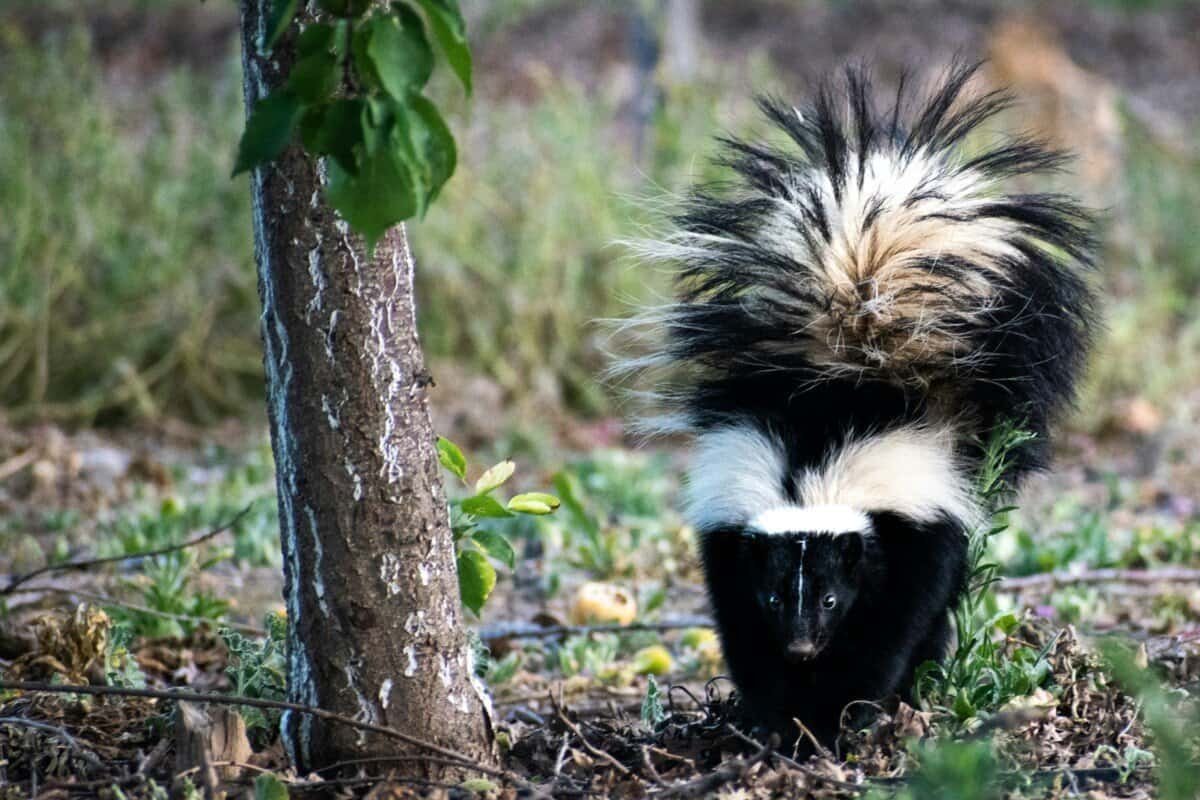
Skunks are one of the easiest wildlife species to deter humanely once you understand what draws them in. The goal is not to punish or frighten them into leaving forever, but to make your property less attractive, less accessible, and less comfortable so they naturally move on. Humane skunk control works best when you combine cleanup, exclusion, and a few practical deterrents rather than relying on a single spray, scent, or scare tactic.
A skunk is usually not entering your yard by accident. It is responding to a meal, a hiding place, or both. That is why the most effective solutions focus on changing the environment instead of trying to “battle” the animal.
Why skunks come around
Skunks are opportunistic foragers. They look for easy food and safe daytime shelter, and suburban yards often provide both. Pet food left outside, spilled birdseed, fallen fruit, open trash, compost, and lawn grubs can all make a yard worth visiting.
They also like protected spaces. Under decks, sheds, porches, steps, and crawlspaces, skunks can den safely away from predators and weather. If your property offers a dark, quiet opening with room to squeeze underneath, a skunk may decide it is a fine place to stay.
That behavior matters because it means skunk problems are usually manageable. You do not need harsh chemicals or lethal control to solve them. You need consistency: reduce the food value of the yard, block the hiding spots, and make the area less appealing over time.
Remove the reasons they stay
The first step is cleanup. If there is nothing worth eating, skunks are far less likely to linger. Bring pet food indoors at night, keep garbage in tightly closed cans, and clean up fallen fruit, nuts, and spilled seed promptly. If you feed birds, use trays or feeders that minimize waste on the ground.
Compost piles deserve special attention. Open or poorly managed compost can attract insects, rodents, and skunks. A covered bin or enclosed system is much better than an open heap. If you keep livestock or poultry feed, store it in sealed containers so the smell and spill risk do not keep attracting wildlife.
Lawns can also be the problem. Skunks often dig for grubs, beetles, and other soil insects. If you see small cone-shaped holes or sections of torn turf, inspect for grub damage. Addressing the insect issue can make your yard much less interesting to skunks, especially in spring and late summer when they forage heavily.
A practical cleanup routine includes:
- Keeping seed and feed in sealed bins.
- Bringing in pet bowls each night.
- Using trash cans with tight-fitting lids.
- Cleaning around outdoor grills and picnic areas.
- Picking up fruit, acorns, and nuts.
- Covering compost.
- Reducing lawn grubs when needed.
Make shelter sites unusable
If a skunk can get under a structure, the cleanup alone may not solve the problem. Shelter is often just as important as food. Skunks are drawn to places that feel hidden and secure, especially if they can raise young there.
The solution is exclusion: physically blocking access so they cannot get into the space in the first place. This is one of the most reliable humane methods because it solves the root cause. A skunk can ignore lights or smells, but it cannot use a space it cannot enter.
Common exclusion materials include hardware cloth, galvanized welded wire, sheet metal, and heavy-duty mesh. The right material depends on the opening, soil conditions, and how permanent the repair needs to be. For most homes, hardware cloth or galvanized welded wire is the most practical choice because it is strong, long-lasting, and easier to shape than rigid metal panels.
If you are closing off a deck, porch, or shed skirt, the material should be sturdy enough that the animal cannot chew, tear, or push through it. The openings in the mesh should be small enough that a skunk cannot squeeze through; smaller openings also help keep out young animals and other pests.
Best materials to deter and for exclusion
For humane skunk control, exclusion works best when the material is strong, corrosion-resistant, and installed tightly. Here are the main options and when to use them.
Hardware cloth
Hardware cloth is a welded wire mesh that is commonly used for wildlife exclusion. It comes in different gauges and mesh sizes, and it is usually one of the best all-around choices for skunks. A smaller mesh opening helps prevent squeezing and digging, while the galvanized finish resists rust.
It is useful for:
- Reinforcing weak spots near the ground.
- Closing gaps under decks and sheds.
- Covering vents or openings.
- Protecting crawlspace access points.
For most wildlife work, hardware cloth is preferred over chicken wire because it is stronger and holds its shape better. Chicken wire can be useful for temporary barriers or very light applications, but skunks and other digging animals can bend or damage it more easily.
Galvanized welded wire
Galvanized welded wire is another strong option for perimeter barriers and skirting. It is durable and relatively easy to install across longer sections. The galvanized coating helps it withstand moisture and outdoor exposure.
This material works well when you need:
- A longer run of barrier around a deck or foundation.
- A stronger perimeter than plastic mesh can provide.
- A barrier that can be fastened to posts or framing.
Choose a wire size that is tough enough not to deform under pressure. If the barrier will sit close to the ground, durability matters more than appearance.
Sheet metal
Sheet metal is often used where a skunk might try to dig beneath a structure. It is especially helpful as a digging apron or as reinforcement near the bottom of a barrier. Metal flashing or heavier sheet metal can be bent into a form that blocks tunneling attempts.
It is useful for:
- The lower edge of skirting.
- Corner reinforcement.
- Areas where repeated digging has occurred.
Sheet metal is not always the only material you need, but it is excellent as part of a layered barrier. It is especially helpful when installed in an outward-facing apron so animals meet an obstacle before they reach the open space beneath the structure.
Concrete blocks or masonry
Concrete blocks, pavers, or masonry edging can also support exclusion efforts. These materials are best used to close off large gaps, define a barrier line, or reinforce an area where the ground is level and stable. They are heavy, durable, and difficult for wildlife to move.
They are useful for:
- Blocking larger access points.
- Supporting fence or mesh edges.
- Creating a permanent perimeter near garden or foundation areas.
Masonry materials are not always the easiest solution for every property, but they work well when you want a more permanent, low-maintenance finish.
Heavy-duty landscape staples and fasteners
The strongest mesh is only as good as its attachment. Use exterior screws, washers, heavy-duty staples, or fencing fasteners to secure the material tightly. The fastening system matters because any loose edge becomes an entry point.
This is especially important near the bottom edge of the barrier. If a skunk can lift or pull at the material, it may eventually open a weak spot. Strong fasteners and close spacing make a big difference in long-term success.
How to install barriers correctly
Installation matters just as much as the material itself. A barrier that looks solid from a distance can still fail if it has gaps at the corners, soft soil underneath, or loose attachment points.
Start by measuring the full opening carefully. Skunks are flexible enough to use surprisingly small spaces, so do not guess at the dimensions. If the underside of a deck or shed is uneven, follow the ground closely so there are no gaps that invite crawling or digging.
The most effective barrier usually extends downward into the ground or outward as an apron. If you bury the bottom edge a few inches into the soil, you make it harder for the skunk to simply walk under it. An outward apron can be even better in some situations because an animal that tries to dig meets a horizontal barrier instead of going straight down.
A good installation often includes:
- Tight fastening to the structure.
- Small mesh openings.
- A buried or apron-style bottom edge.
- Reinforced corners.
- No loose panels or gaps.
- Materials that resist rust and weather.
If the area is already active, inspect carefully before closing it. You want to make sure the skunk is not inside when you seal it. Humane exclusion means giving the animal a way out first, then closing the space once it has left.
Use light, water, and sound deterrents
Skunks prefer dark, quiet spaces, so motion-triggered deterrents can help. Motion-activated lights are simple and useful around patios, sheds, gardens, and den entrances. Sudden brightness can interrupt movement and make the area feel less secure.
Motion-activated sprinklers are even more effective in many cases because they add surprise without harm. The sudden burst of water is usually enough to teach a skunk that the area is unpleasant, especially near flower beds or known travel paths. They are often better than constant sprinklers because the trigger keeps the animal from getting used to them.
Sound deterrents can also help, although they tend to be the least reliable of the three. A radio or other intermittent noise source may encourage a skunk to relocate temporarily. But because skunks are adaptable, sound alone rarely solves a long-term problem.
These tools work best when used together with exclusion and cleanup. A motion light by itself may not matter if the skunk still has a full food source and a secure den. When the environment becomes both uncomfortable and unrewarding, skunks are much more likely to leave.
Scent repellents and their limits
Some homeowners try odor-based repellents such as ammonia, vinegar, citrus, or commercial capsaicin-based products. These can create short-term annoyance, especially near openings or travel routes. They may help as a temporary backup measure while exclusion work is underway.
But scent repellents are rarely enough on their own. Wind, rain, and time reduce their effect quickly, and some skunks will tolerate the smell if the food or shelter is appealing enough. In other words, odor deterrents can support a plan, but they should not be the core of it.
It is also important to avoid unsafe substances. Never use poisons, glue traps, or harsh chemicals that could injure pets, wildlife, or people. Humane deterrence should be effective without creating secondary harm.
Keep the yard less attractive
A yard with fewer hiding spots is less appealing to skunks. Remove brush piles, unused boards, stacked lumber, and clutter near foundations. Trim dense shrubs near the ground and keep grass reasonably short so the property is easier to inspect and less inviting as cover.
Pay special attention to low, protected areas. Skunks like places where they can move unseen and where the ground stays dry. Window wells, crawlspaces, hollow spaces under steps, and gaps behind stored items can become repeated problem spots if they are not addressed.
Garden areas can also benefit from small changes. Low fencing, buried edging, and strong borders can reduce digging and browsing. Skunks are not big jumpers, but they are determined diggers, so a barrier that stops tunneling is often more effective than one that only stands above ground.
What not to do
If your goal is humane control, avoid methods that cause suffering or unnecessary fear. Do not use poison, live traps without a relocation plan, glue boards, or lethal control unless you are following local wildlife rules and working within legal and ethical guidelines. These methods often create more problems than they solve.
You should also avoid aggressively confronting a skunk. Chasing it, cornering it, or trying to handle it by hand greatly increases the chance of a spray response. The best results come from calm, indirect pressure: make the area less usable, not more dramatic.
Mothballs, random home remedies, and strong chemicals are not dependable answers. Some are ineffective, and others can create health or environmental risks. A humane approach should be practical, repeatable, and safe for the whole household.
If a skunk is already denning
When a skunk has already taken up residence under a porch, shed, or deck, the answer is usually not force. It is planned exclusion. In many cases, the animal can be encouraged to leave on its own if the opening is left clear for a time and then sealed only after the space is empty.
One-way exclusion can be effective. The idea is to allow the skunk to exit but prevent re-entry. Once you are confident the den is empty, you can install the permanent barrier using the materials described earlier. This method is often the cleanest and most humane way to resolve the situation.
If there are babies, timing becomes even more important. A mother skunk may use the den for a period while raising young. Sealing the opening too soon can trap them inside, which is both inhumane and likely to create odor and sanitation problems. When a den is active, it is worth being patient and careful rather than rushing the repair.
A practical step-by-step plan
The most reliable humane approach is a layered one. You are not trying to frighten skunks into disappearing forever. You are teaching them that your property is no longer an easy, safe place to feed or den.
A simple plan looks like this:
- Remove food sources.
- Find and seal shelter openings.
- Use motion lights or sprinklers in problem areas.
- Apply temporary scent deterrents if needed.
- Install durable exclusion materials.
- Check the area regularly for new digging or weak spots.
That sequence works because it addresses the real drivers of skunk behavior. First you remove the reward, then you remove the shelter, and finally you reinforce the boundary so the animal cannot return. It is a much better long-term solution than trying to rely on a single spray or smell.
Final thoughts
The safest and most humane way to deter skunks is to make your property less useful to them. Clean up food attractants, block access to sheltered spaces, and use simple deterrents like motion lights or sprinklers to encourage them to move along. The most important long-term step is exclusion, and that means using durable materials such as hardware cloth, galvanized welded wire, sheet metal, and strong fasteners to close off access points.
When you do the work carefully, skunks usually leave without harm. That protects the animal, reduces stress for your household, and gives you a cleaner yard with fewer surprises. Humane control is not just kinder; it is usually the most effective answer as well.