
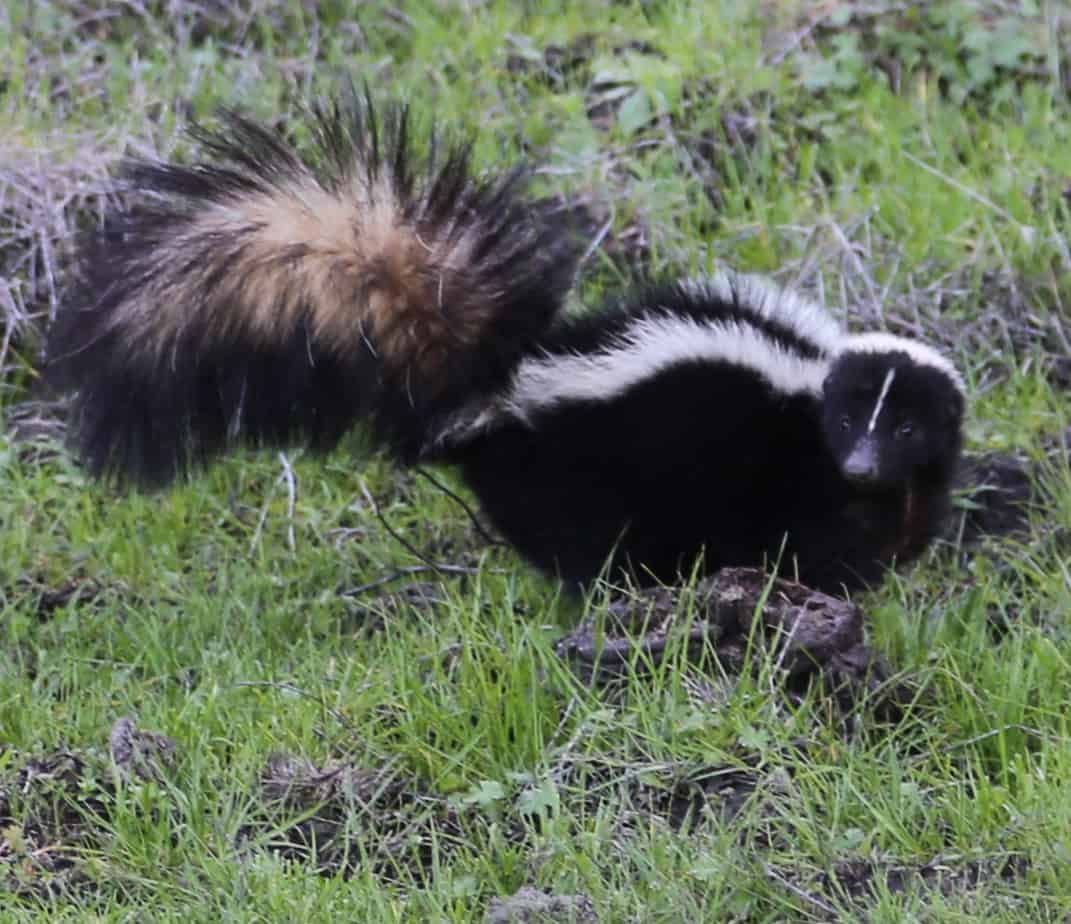
Skunks are among the most recognizable mammals in North America, but not all skunks look alike. While the striped skunk is the species most people know, spotted skunks, hognosed skunks, and hooded skunks each have distinct features that make them easier to identify once you know what to look for.
This guide explains how to identify the main skunk species by size, stripe pattern, snout shape, and habitat. Whether you are a wildlife watcher, homeowner, or nature enthusiast, these clues will help you tell one species from another with more confidence.
Why skunk species identification matters
At first glance, many skunks seem similar because of their black-and-white coloring. But once you look more closely at body shape, markings, and facial structure, the differences become much easier to see. Correct identification helps you understand the animal’s range, habitat, and likely behavior.
It also helps avoid common mistakes. People often assume every black-and-white skunk is a striped skunk, but that is not always true. Spotted skunks, hognosed skunks, and hooded skunks each have their own distinctive traits.
Species-level identification also helps avoid confusion with juveniles or partially seen animals. A quick nighttime glimpse of a black-and-white mammal is often not enough to tell the whole story. The more species you know, the easier it becomes to make a reliable identification from a brief sighting.
The Main Skunk Species to Know
Several skunk species occur in North America, but a few are especially important for everyday identification.
- Striped skunk: The most familiar skunk, with bold white stripes on a black body.
- Spotted skunk: Smaller and more slender, with broken stripes and spots.
- Hognosed skunk: Larger, stockier, and distinguished by a long piglike snout.
- Hooded skunk: Marked by a dramatic white “hood” or mantle over the body and tail, with a very different look from the striped skunk.
Depending on the region, you may also hear about other skunks such as western spotted skunks, eastern spotted skunks, and regional forms of hognosed skunks. For a general field guide, however, these four are the most useful species to learn first.
Striped Skunk Identification
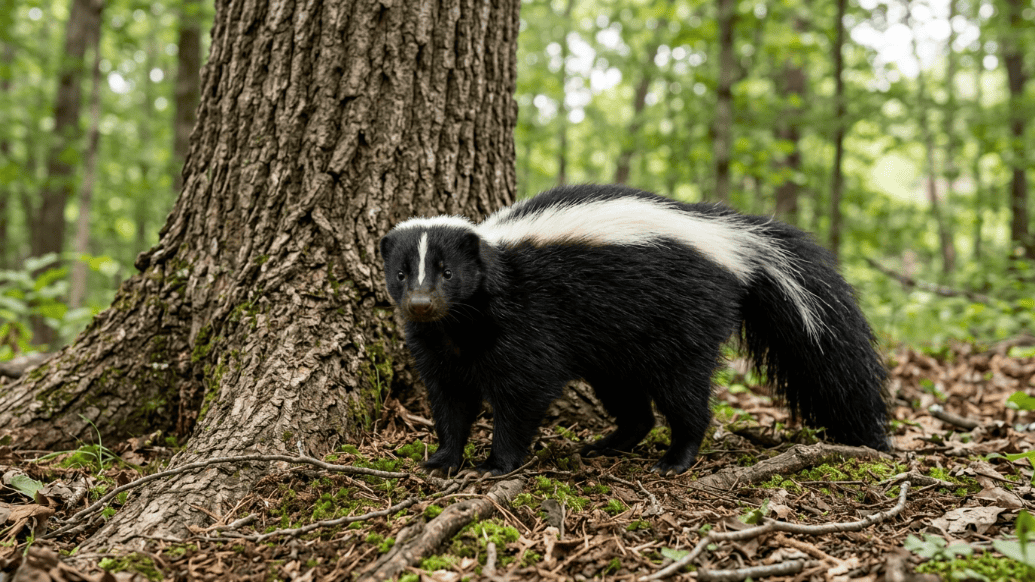
The striped skunk is the classic species most people picture when they hear the word “skunk.” It is usually medium-sized, with a black body and one or two broad white stripes that begin on the head and continue down the back. In many individuals, the stripes split over the shoulders and may join or separate again near the tail.
Striped skunks are typically about the size of a house cat. They have a compact body, short legs, small ears, and a thick, bushy tail. Their markings are usually bold and easy to see, especially in good light. The tail is commonly black and white mixed, though the exact pattern can vary.
This species is widespread and highly adaptable. It is found in farmland, brushy fields, wooded edges, suburban neighborhoods, and many other habitats. Because it is so common, it is often the species people think of first when they see a skunk near a home or road.
If the animal is medium-sized and shows a clear stripe pattern rather than spots or a hood-like marking, the striped skunk is the most likely identification.
Spotted Skunk Identification
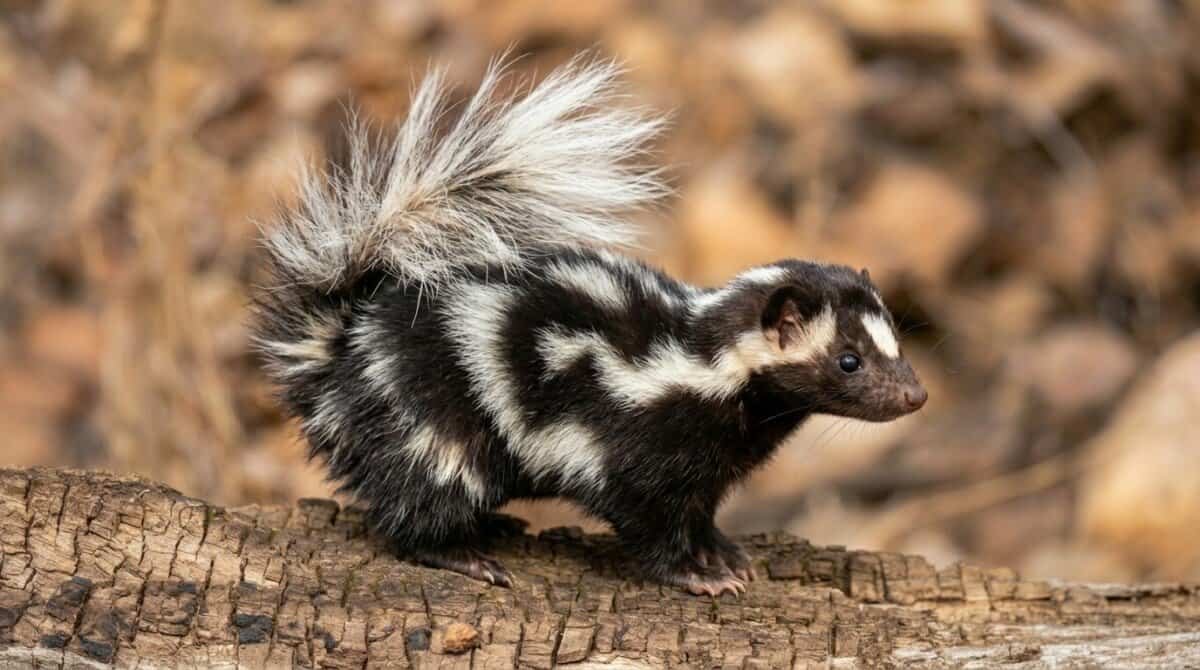
Spotted skunks are smaller and more agile-looking than striped skunks. Instead of a bold continuous stripe, they usually show broken white stripes, white spots, or irregular patches that create a more speckled appearance. These markings are often less symmetrical and more fragmented than those of a striped skunk.
A white spot on the forehead is a common clue, along with white markings near the ears or on the sides of the body. The face often looks more patterned than that of a striped skunk. Spotted skunks are also noticeably slender, with a longer and narrower body than the more robust striped skunk.
Their tails can be long and bushy, sometimes with a white tip. Because they are smaller, the tail may look proportionally more prominent. Some spotted skunks also carry themselves with a more nimble, quick-moving posture, which can help separate them from the slower, more deliberate striped skunk.
Spotted skunks are often overlooked because they are less familiar and more secretive. If the skunk looks small, lightly built, and patchy rather than boldly striped, spotted skunk is the best match.
Hog-nosed Skunk Identification
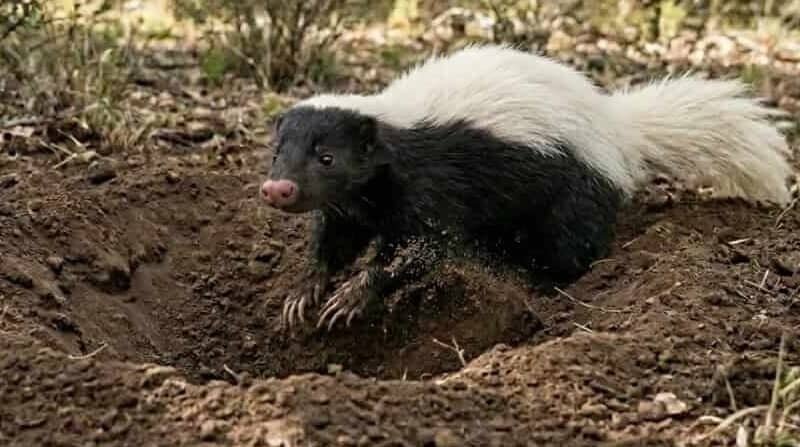
Hog-nosed skunks are especially distinctive because of their snout. They have a long, broad, piglike nose that stands out immediately when you see the animal from the side or front. This feature is the easiest way to identify them and is the reason for the name “hog-nosed.”
These skunks are generally larger and stockier than striped or spotted skunks. Their bodies look robust, and they often have a broad white stripe or a white-backed appearance. The tail is usually bushy, and the overall impression is heavier and more substantial than that of the smaller skunk species.
The snout is a major clue not only for identification but also for behavior. Hog-nosed skunks use that long nose for digging and rooting, which makes them look and act somewhat different from other skunks. If an animal appears to be rooting in soil and has a very long face, the hog-nosed skunk is the species to consider.
This species is often associated with more southwestern regions and certain brushy or open habitats. It is less likely to be seen in many suburban settings than striped skunks, so its unusual appearance often surprises people the first time they encounter one.
Hooded Skunk Identification
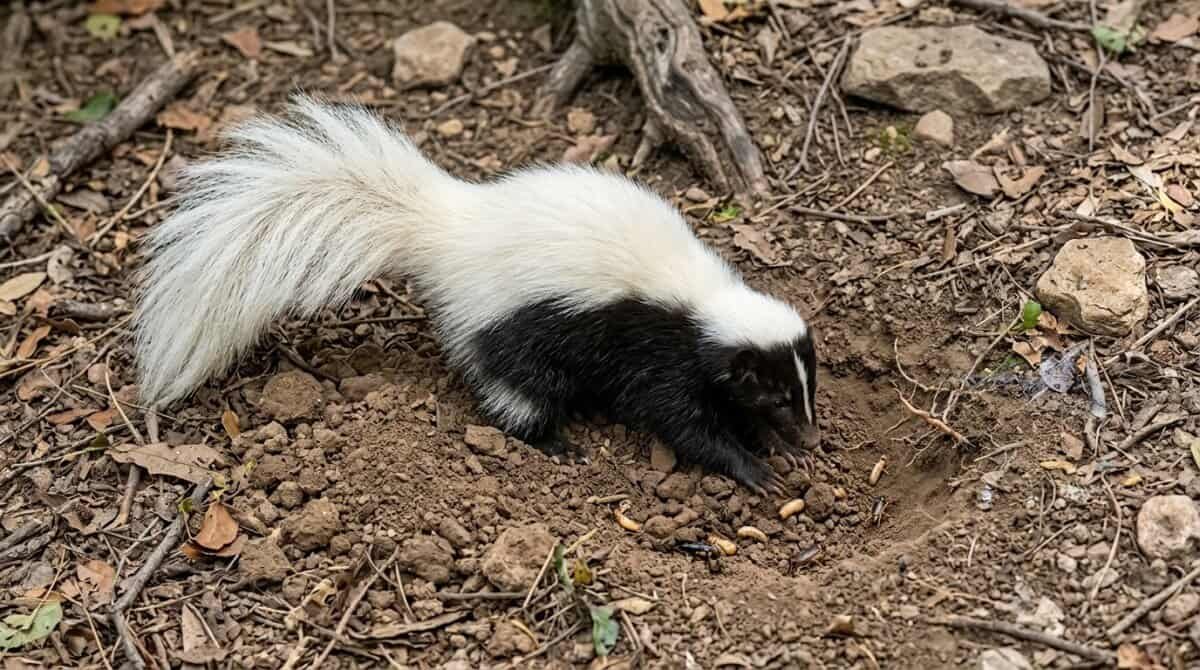
Hooded skunks are one of the most visually striking skunk species. Instead of the familiar narrow stripe pattern seen in striped skunks, hooded skunks have a broader white pattern that creates the appearance of a white “hood,” mantle, or cape over the back and body. In many cases, the white fur extends over much of the head, shoulders, and back, making the animal look dramatically different from a striped skunk.
The exact pattern can vary, but the key idea is that the hooded skunk often looks more white-backed and less sharply striped. The tail is also often long and fluffy, with a bold black-and-white contrast that adds to the overall dramatic appearance. Compared with striped skunks, hooded skunks can look more elongated and more heavily patterned in white.
Hooded skunks are more regionally distributed and are often associated with parts of the southwestern United States and Mexico. They are not the skunk most people expect to see in a backyard or suburban edge habitat, which is part of why they are so interesting to wildlife observers. Their range and appearance make them a distinctive species worth knowing if you are expanding beyond the standard striped-skunk guide.
If you see a skunk with a broad white mantle, large white patches, and a more dramatic “hooded” appearance than a typical striped pattern, you may be looking at a hooded skunk rather than a striped one.
Side-by-Side Species Comparison
Here is a simple comparison to help separate the species quickly:
| Species | Main pattern | Body size | Best clue |
|---|---|---|---|
| Striped skunk | Bold white stripes on black fur | Medium-sized | Clear back stripe |
| Spotted skunk | Broken stripes and white spots | Small and slender | Patchy markings and white forehead spot |
| Hognosed skunk | White-backed or broad-striped look | Large and stocky | Long piglike snout |
| Hooded skunk | Broad white hood or mantle | Medium to large | Dramatic white cape-like pattern |
This comparison shows why pattern alone is not always enough. The body shape and face structure are just as important as the color pattern.
Habitat and Range Clues
Habitat can help narrow the species if the markings are not enough. Striped skunks are by far the most adaptable and widespread. They are commonly found in fields, wooded edges, farms, suburbs, and many other places where cover and food are available.
Spotted skunks tend to prefer brushy cover, rocky areas, mixed habitats, and more secluded environments. They are generally seen less often by people, in part because of their small size and secretive habits. When they are present, they may stay close to dense cover and avoid open areas.
Hognosed skunks are more associated with certain regions, especially parts of the Southwest and nearby areas. They are often linked to habitats where digging and rooting are useful for finding food. Their range is more restricted than that of striped skunks.
Hooded skunks are also more regional and are especially associated with the southwestern part of North America and Mexico. If you are outside that range, you are less likely to encounter one. Knowing where a species tends to occur is one of the best ways to support a visual identification.
Behavior Clues That Help
Behavior is another useful clue when the animal is moving. Striped skunks often move slowly and deliberately, with a calm waddling gait. They are confident but not especially quick. That makes their movement style fairly easy to recognize.
Spotted skunks may appear more agile and lively. Their smaller size and lighter frame can make them seem more nimble. They are often seen moving through denser cover or more uneven terrain, where quick movement helps them stay hidden.
Hognosed skunks behave like diggers and rooters. Their nose is built for probing soil and leaf litter, so they often look as though they are searching actively underground or near the surface. That rooting habit can make them stand out from the other species.
Hooded skunks can also show deliberate foraging behavior, but their look is usually the bigger clue than their movement. A large white mantle or hood pattern is hard to miss once you have seen it clearly.
Common Mistakes When Identifying Skunks
One of the most common mistakes is assuming all skunks with black-and-white fur are striped skunks. That assumption works some of the time, but it fails when the animal is actually a spotted, hognosed, or hooded skunk.
Another mistake is relying too heavily on a quick glimpse of the back. A skunk seen from behind may show only tail pattern or a patch of white fur, which is not enough for a confident identification. The face, body size, and overall shape matter just as much.
People also sometimes confuse hooded skunks with striped skunks because both can have white on the back. The difference is that hooded skunks often have a broader, more dramatic white pattern that looks like a mantle or hood rather than narrow stripes.
Hognosed skunks are sometimes misidentified because observers focus on the coat and miss the nose. If you see a skunk with a very long, piglike snout, that feature should outweigh the coat pattern in your identification.
Simple Skunk Identification Checklist
Use this checklist the next time you spot a skunk:
- Bold narrow stripes, medium body: striped skunk.
- Small body, broken stripes, and white spots: spotted skunk.
- Large body and long piglike nose: hognosed skunk.
- Broad white hood or mantle over the back: hooded skunk.
- Patchy markings with a small frame: likely spotted skunk.
- White-backed look with a dramatic outline: likely hooded skunk.
This checklist is a practical way to make a fast field identification when you do not have time to examine every detail.
Skunk Species at a Glance in Nature
In real-world observations, skunks are often seen only briefly. That is why a layered approach works best. Start with the size of the animal. Then look at the stripe pattern. Finally, check the face and tail. Using all three features together will usually lead to the right answer.
A striped skunk has the most familiar profile and the clearest stripe pattern. A spotted skunk is smaller and patchier. A hognosed skunk has the most unusual face. A hooded skunk has the most dramatic white back and mantle. Once you know these differences, you can identify most skunk sightings much more quickly.
Wrapping Up
Skunks may all seem similar at first, but the differences between species are easy to recognize once you know what to focus on. Striped skunks are the classic bold-striped animals most people know. Spotted skunks are smaller and marked with broken patterns. Hognosed skunks are larger and distinguished by their long snouts. Hooded skunks stand out because of their broad white hood-like markings.
If you remember only a few things, remember these: stripe pattern, size, snout shape, and overall body build. Those four clues will help you separate the main skunk species far more reliably than color alone. The more you observe, the easier the distinctions become.