
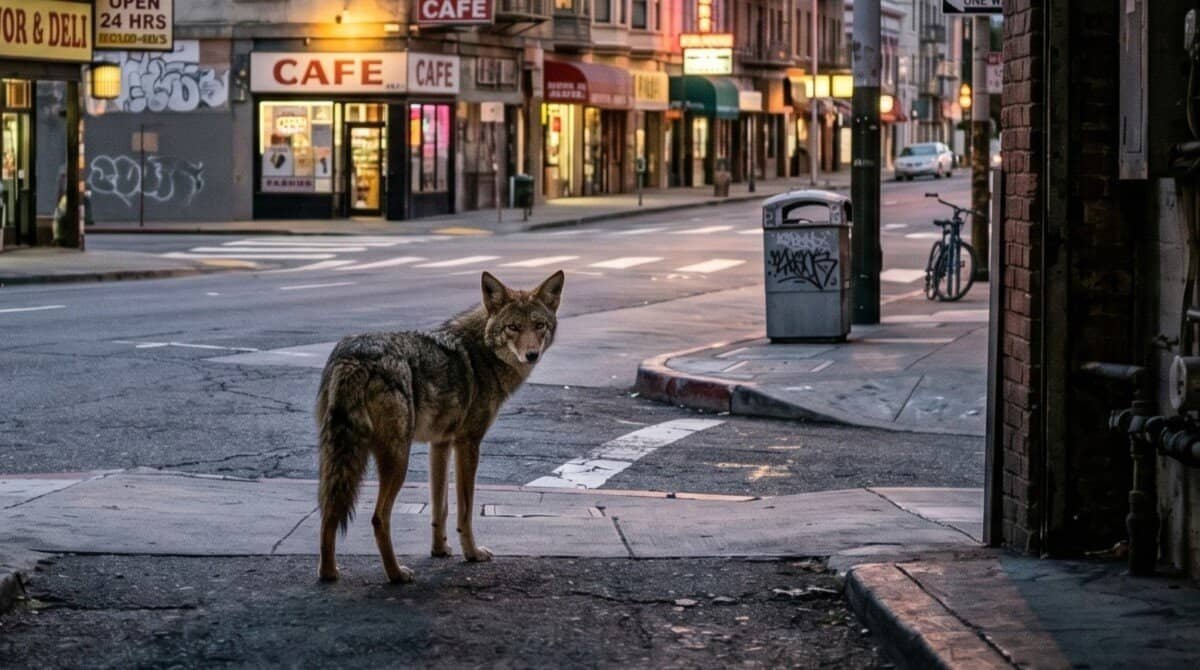
Coyotes have become one of the most familiar wild animals in suburban and urban America, and their success is no accident. They are adaptable, cautious, and remarkably good at living near people without fully depending on them. Where many species struggle when forests are broken into smaller pieces by roads, homes, and commercial development, coyotes often manage to turn those same changes into an advantage.
Their ability to live in cities and suburbs comes from a combination of flexible behavior, broad diet, and a willingness to use spaces other animals avoid. They can move through fragmented habitat, take advantage of food sources tied to people, and persist in places where larger predators are rare or absent. That makes them a useful example of how wildlife can adjust to human-altered landscapes.
Built for flexibility
Coyotes belong to the dog family and are known scientifically as Canis latrans. They are mid-sized canids with a body and behavior pattern that favors versatility over specialization. That matters because urban environments are not simple places. They are a patchwork of streets, yards, parks, rail lines, drainage channels, vacant lots, and wooded strips.
A species that can use several different habitat types has a real advantage in that kind of setting. Coyotes do not need a large untouched wilderness to survive. They need food, cover, and room to move. Cities and suburbs often provide all three, even if no one planned them that way.
Their spread across North America is one of the clearest wildlife success stories of the modern era. Coyotes once lived mainly in western landscapes, but they have expanded into much of the continent. Human land use played a part in that expansion by changing habitats and reducing competition from larger predators. In that sense, the coyote is not simply forcing its way into cities; it is responding to a world humans reshaped.
Coyotes also learn quickly. An individual animal can remember where food is found, when people are most active, and which routes are safest. That kind of learning is especially valuable in urban areas, where conditions can shift from one block to the next. A coyote that adjusts well to local conditions is far more likely to stay alive and reproduce.
Fragmented landscapes
To a person, a city may look like a broken landscape with too many barriers. To a coyote, it can function as a network of usable spaces. Coyotes are especially good at moving through fragmented habitat by following cover and avoiding open, risky places. A creek corridor, a fence line, a rail embankment, or a string of backyards can all help connect larger habitat patches.
Fragmentation is usually hard on wildlife because it limits movement and makes resources harder to reach. Coyotes handle it better than many animals because they are willing to travel along edges rather than through exposed open ground. Those edge areas are useful because they provide concealment and often contain prey.
That is one reason suburbs and cities can be attractive to coyotes. They are full of edges. Streets meet lawns. Houses meet drainage ditches. Parks meet roads. Industrial zones meet wooded strips. These transitional spaces create a kind of map that coyotes can use efficiently.
Fragmented landscapes can also support a surprising amount of prey. Rodents, rabbits, and other small mammals often do very well around human development. Landscaped yards, ornamental shrubs, vacant lots, and drainage features can all create shelter and feeding opportunities for these smaller animals. Coyotes benefit because they are skilled hunters of exactly that kind of prey.
Linear features matter too. Greenways, stream corridors, utility rights-of-way, and railroad corridors can function like travel lanes. They allow coyotes to move across developed landscapes without spending too much time in the most exposed areas. The coyote’s success depends in part on this ability to use the seams of the landscape.
Seasonal changes also shape movement. At certain times, coyotes travel more widely in search of food or to disperse into new territory. Urban and suburban habitat can still support that behavior because it is not completely sealed off. Even small bits of cover and food may be enough for a predator that knows how to take advantage of them.
Human-provided food
Another major reason coyotes do so well around people is the food people create or leave behind. These are not always direct handouts. Often they are accidental subsidies created by human activity. Coyotes are opportunists, and that makes them very effective at using those resources.
They may hunt rodents living near homes and businesses. They may eat fruit from ornamental trees or shrubs. They may scavenge carrion, take advantage of pet food, or make use of improperly stored garbage and compost. The key point is that they are not tied to just one food source. They can shift to whatever is easiest and most dependable.
That flexibility matters because food conditions in urban areas can vary a great deal. One neighborhood may have plenty of rodents. Another may produce seasonal fruit. Another may have trash or compost that attracts scavengers. Coyotes can adjust to all of those situations.
They are not merely scavengers, even though that is how many people think of them. They are still capable hunters and often depend heavily on live prey. What sets them apart is their willingness to switch between hunting and scavenging depending on what the landscape offers. In a city, that kind of flexibility is a major survival tool.
Human food sources also influence the broader food web. Rodents often thrive around people, and coyotes know it. When prey species become plentiful near structures, coyotes learn to use those areas. In that way, the city becomes a functioning ecosystem rather than just a built environment.
Fewer large predators
Coyotes also benefit from the fact that many urban and suburban areas lack larger predators. In intact ecosystems, wolves, mountain lions, or other big carnivores can limit coyote numbers through competition or direct predation. In many cities, those animals are absent or rare. That gives coyotes more room to establish territories and raise young.
This does not mean life is easy for them. They still face vehicles, disease, human conflict, and the hazards of fragmented habitat. But from a predator-competition standpoint, they often have fewer threats than they would in a more complete wild ecosystem. Less pressure from larger predators creates more room for them to use available space.
Coyotes also tend to be better than many other mid-sized carnivores at surviving in disturbed landscapes. They are large enough to hold territory and flexible enough to adjust to changing food supplies. That combination gives them an advantage when landscapes are crowded, altered, and unpredictable.
Their reduced need to avoid larger predators also influences how they behave. They can use territories more confidently and often spend time in resource-rich areas while still staying cautious. That caution is important. Urban coyotes are not reckless animals. They survive by balancing risk and reward very carefully.
This is one reason they have become common in places where many people never expected to see a wild predator. The absence of larger carnivores opens ecological space, and coyotes are the species best able to fill it.
How they act around people
Coyotes near people often change their behavior in subtle but important ways. They may become more active at night, at dusk, or in the early morning when human activity is lower. They often use cover, edges, and hidden routes to get from one place to another. That lets them remain present without being noticed very often.
Some people assume urban coyotes are becoming tame, but that is not really what is happening. They are still wild animals. What changes is how they behave. They learn when to move, where to avoid, and how to stay out of trouble.
That ability to adjust is one of the main reasons they succeed in cities. A coyote that knows how to avoid people while still using the landscape has a better chance of surviving than one that cannot. Over time, the individuals that make the best decisions are the ones most likely to pass on their genes.
Learning within the family also plays a role. Young coyotes often learn from adults where to travel and what to avoid. That means successful urban behavior can be passed from one generation to the next. A pair that figures out how to live well in a city can raise pups that carry those habits forward.
People sometimes underestimate how aware coyotes are of their surroundings. A sudden sighting may create the impression that they are careless or aggressive, but in most cases they are highly alert and very selective about when they move. Their behavior is usually cautious, not bold.
Their broad diet
The coyote’s diet is one of the strongest reasons it thrives in suburbs and cities. Coyotes are opportunistic omnivores, although they prefer meat. In practice, that means they can eat a wide range of foods depending on what is available. In urban settings, that flexibility becomes especially useful.
Rodents are often an important food source around human development. Rabbits may also be common, especially in edge habitats and landscaped areas. Coyotes may also eat insects, carrion, fruits, and other accessible foods. In some places, human-related food sources become a noticeable part of the diet.
That flexibility is valuable because urban food sources are not steady. One neighborhood may have abundant rodents. Another may have fruiting trees and shrubs. Another may offer trash or compost. Coyotes can make use of all of those options.
Their ability to switch diets also helps them during lean periods. If one food source declines, they can move to another. That makes them much less vulnerable than animals that depend on a narrow range of prey. In a patchwork landscape, that adaptability is a powerful advantage.
Coyotes are not dependent on humans, but they are very good at using what people leave behind. That is one of the reasons they have become so successful in places where more specialized wildlife has struggled.
Family structure and reproduction
Coyotes usually live in family groups or as breeding pairs. A mated pair often forms the center of a territory, and pups stay with the adults for a time before dispersing. In urban settings, that family structure can be very helpful because it allows the young to learn local conditions from experienced adults.
Urban areas can support reproduction when they provide enough cover and food. Brushy spots, drainage corridors, embankments, and similar concealed places can work as den sites. A city does not need to look wild to support coyotes. It only needs to provide the right mix of resources and protection.
Family groups also help make coyote populations stable over time. Once a pair establishes a territory and successfully raises young, that area may continue supporting coyotes for years. Even when one animal is lost, another may move in if the conditions remain suitable. That creates long-term continuity in neighborhoods and green spaces.
This social flexibility is part of why coyotes are so resilient. They do not rely only on individual strength. They use family behavior, territoriality, and learning to support survival across generations. That makes them well suited to landscapes where resources are available but scattered.
Why the city works
Cities can seem hostile because they are loud, busy, and heavily modified. But for coyotes, they are only partly hostile. People are active in some places and at some times, but not everywhere all the time. Roads create risk, but they also create patterns coyotes can learn. Buildings remove some habitat while creating edges and cover in other places.
Coyotes succeed because they know how to balance danger and opportunity. They can stay out of busy places, travel when conditions are safer, and use food sources without being obvious. That gives them a major advantage in human-dominated landscapes.
Suburbs and exurban areas are often especially good for coyotes because they combine cover, prey, and lower disturbance. These transitional landscapes sit between dense development and larger open spaces. That mix gives coyotes the resources they need while still allowing them to remain relatively hidden.
Cities are not empty places. They are ecosystems. Coyotes are one of the clearest examples of how wildlife can adapt to that reality. Their presence shows that nature does not vanish when people build roads and houses. Instead, it changes shape
What coyotes teach us
Coyotes thrive in suburbs and cities because they are adaptable, not because urban areas are perfect habitat. Their success shows that species able to adjust quickly to change often do better in human-altered environments than species that depend on stable conditions.
Their story also shows how tightly wildlife and human land use are connected. Fragmented habitat, food subsidies, and reduced pressure from larger predators all create opportunities for coyotes. As long as those conditions remain, coyotes are likely to stay part of suburban and urban life.
They are not an odd exception. They are a clear example of how resilient some wild animals can be when the world changes around them. The coyote is a predator built for flexibility, and modern landscapes reward exactly that trait.
In the end, the coyote does not need untouched wilderness to survive. It needs enough food, enough cover, and enough flexibility to make use of what people have created. That is why it has become one of the most successful wildlife species in North America’s suburbs and cities.